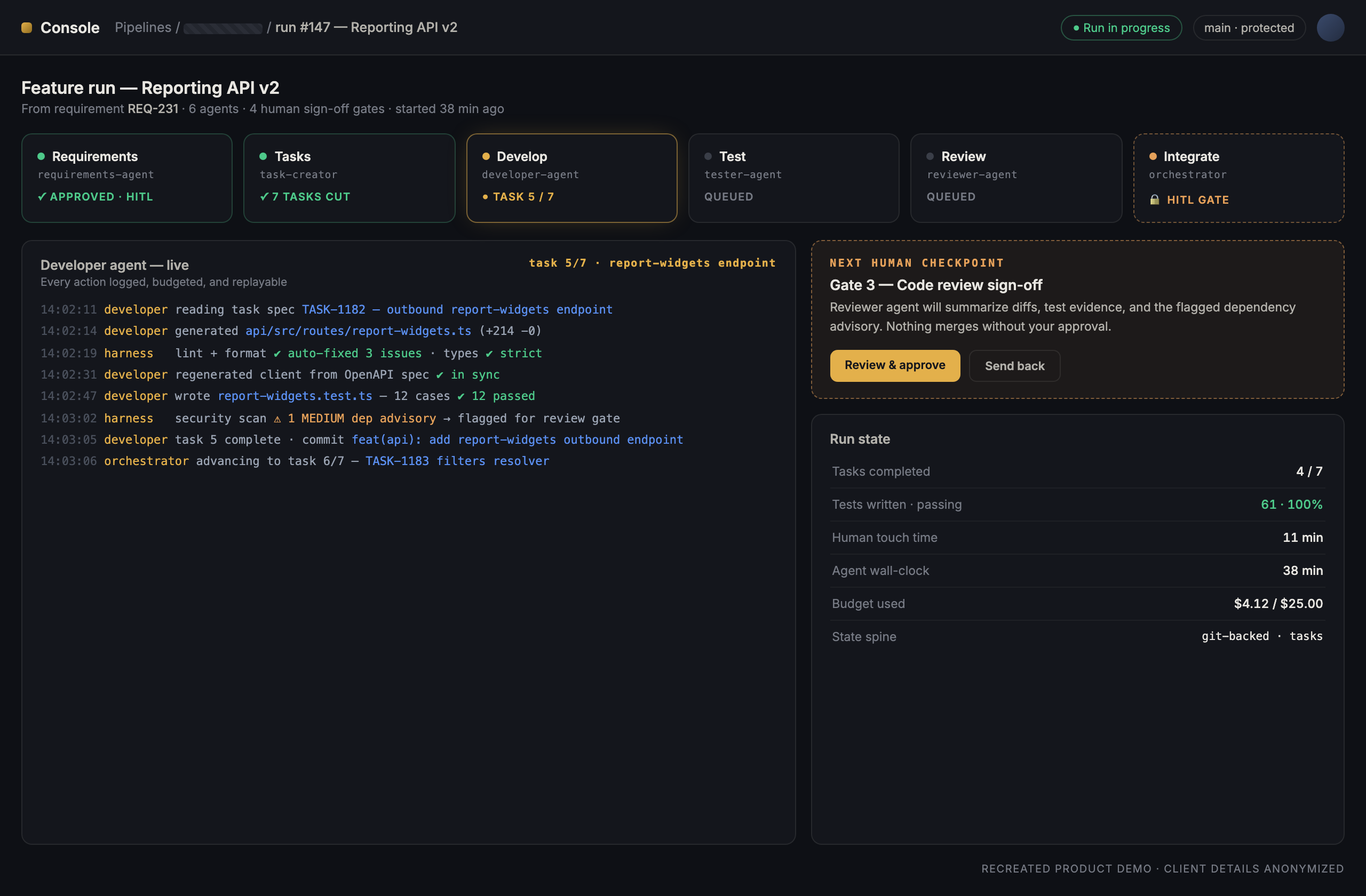
For an enterprise client: a multi-agent platform that takes a feature from written requirement to reviewed, tested, integration-ready code — replacing a whole chain of dev and product tasks with automation, while humans keep signature authority at every gate that matters.
The client's small dev team was drowning: feature requests arrived faster than they could be triaged, let alone built. Intake consumed engineering time; requirements arrived vague; the business waited weeks for changes that took hours to code. The bottleneck wasn't typing speed — it was the entire pipeline of tasks around the code: gathering requirements, cutting tickets, testing, reviewing, coordinating.
The ask: automate that pipeline end to end — without giving up human judgment on what gets built and what ships.
We designed a team of specialized agents, orchestrated as a pipeline, each mirroring a role the humans were drowning in:
Interviews the requester, captures functional requirements in a structured form, and flags ambiguity instead of guessing through it. Non-technical staff self-serve — no developer babysitting intake.
Converts approved requirements into scoped, actionable tasks with acceptance criteria — deliberately create-only, so the agent can propose work but never silently rewrite the plan.
Implements tasks inside a guardrailed harness: strict types, generated API clients from the OpenAPI spec, lint and format on every write, security scanning on every push.
Validates the developer agent's output through the repo's own test frameworks — the agents check each other's work before any human spends attention on it.
Reviews for standards, architecture, and risk; routes issues back to the developer agent and escalates judgment calls to the human gate instead of making them itself.
Drives the pipeline, enforces gate order, tracks budgets and state. Gates are structural — they cannot be bypassed by a clever prompt, because the orchestrator, not the LLM, owns the workflow.
Four checkpoints stand between an idea and shipped code — requirements approval, task-plan approval, code-review sign-off, and integration release. At each one the pipeline stops and presents evidence: what was asked, what was built, what was tested, what was flagged. Approval is a deliberate human act, recorded in the run's state.
Everything an agent does is logged, budgeted, and replayable — cost caps per run, an audit trail per action, and a paper trail from every commit back to the requirement that motivated it. That's what makes "the agents built it" an acceptable sentence in an enterprise.
The plugin architecture means new agents drop into the pipeline as steps — a compliance-review agent, a security-review agent, specialized GUI or database developers — without touching the core. And the same agent team runs two ways: as a package developers import into their own repos, and as a console where non-technical users turn requests into validated, prioritized work.
We build the pipeline that turns intake into shipped software — with your people in command.
info@oandaconsult.com